
The Restructuring Conversation Every Nonprofit Should Have
If you have led a nonprofit, then at some point you have likely wondered: will this organization survive? This question is an elephant in the room that we're not discussing openly enough. Not all nonprofits will survive this challenging landscape which includes defunding, attacks on their work, decreased staffing capacity, and a shrinking social safety net that increases demand for services. Whether your organization has a $300,000 budget or a $30 million budget, you should be having board-level conversations about what types of restructuring might be necessary.
What is Nonprofit Restructuring?
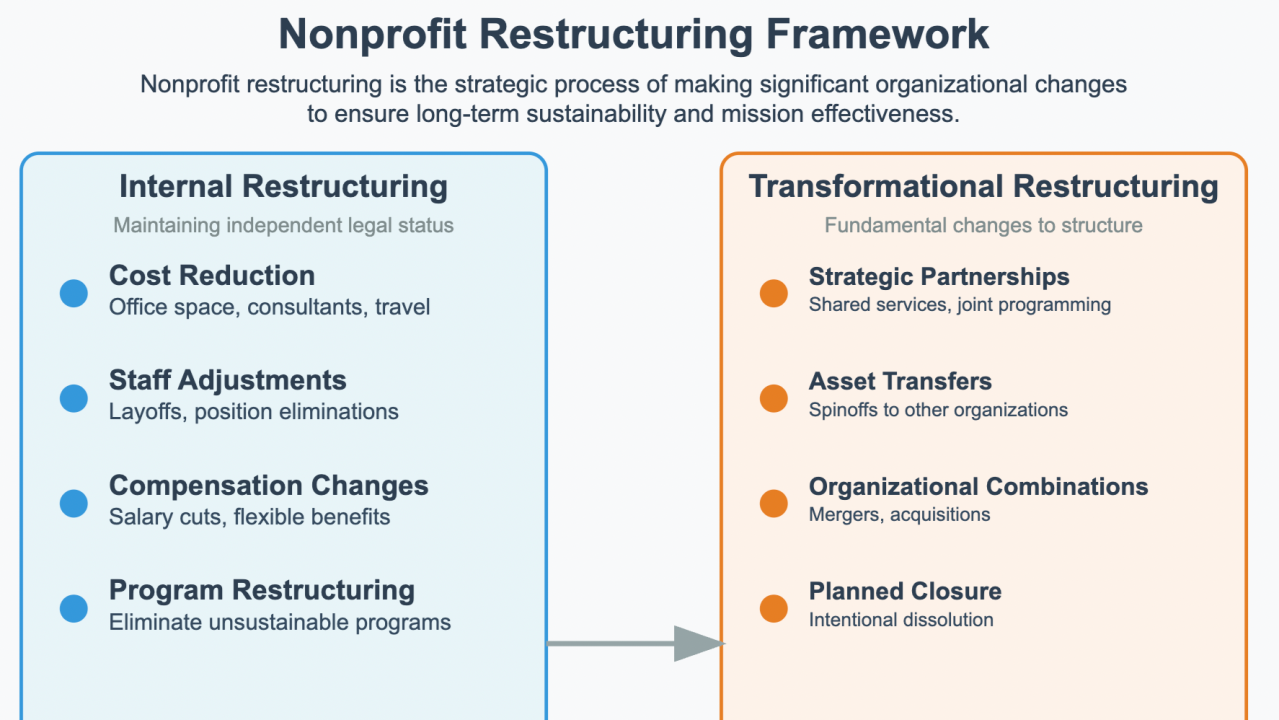
Nonprofit restructuring is the strategic process of making significant organizational changes to ensure long-term sustainability and mission effectiveness. Restructuring helps organizations make intentional choices about their future.
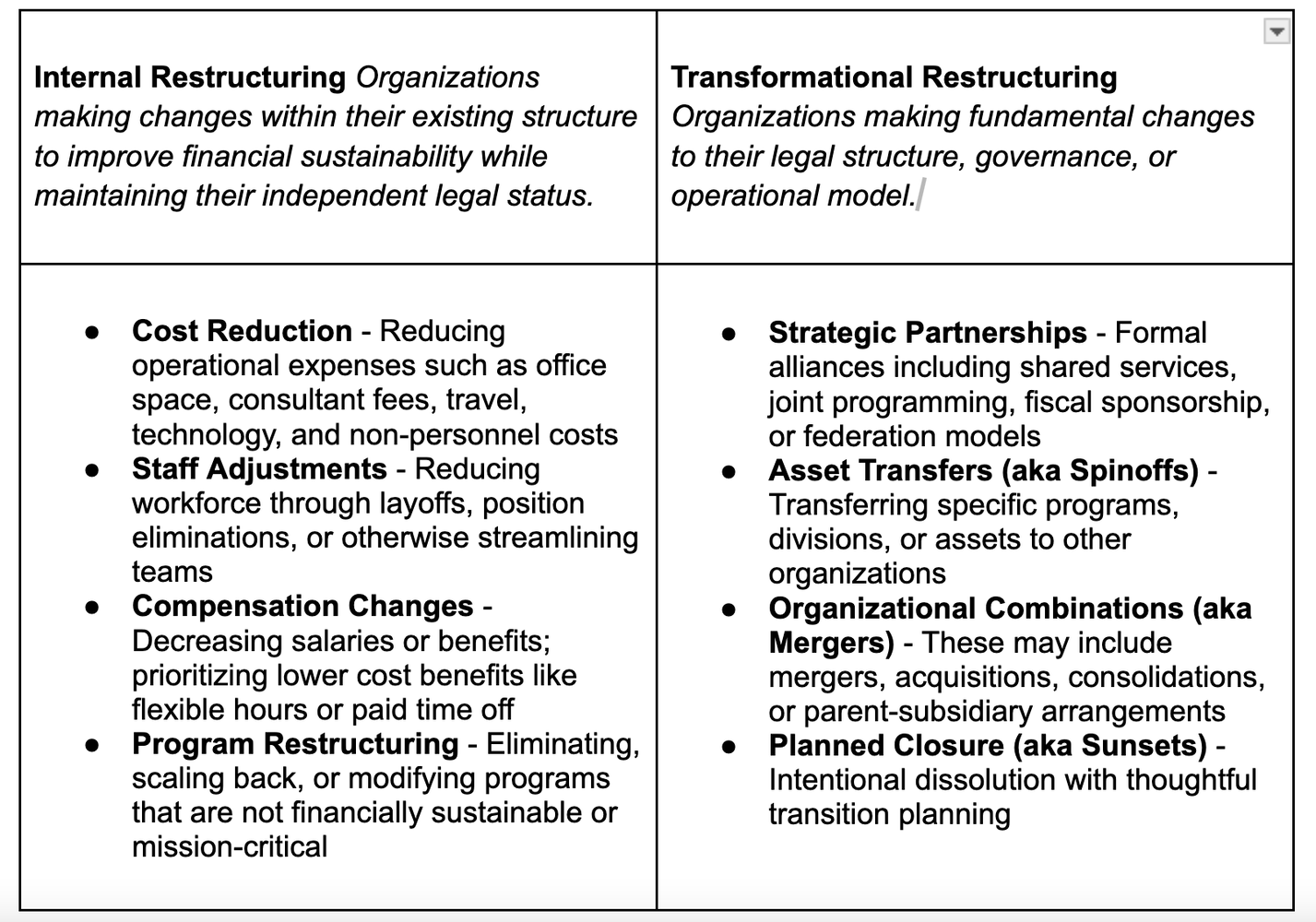
I have observed two main approaches to restructuring: Internal Restructuring, where organizations make changes within their existing legal structure to improve operations and financial health, and Transformational Restructuring, where organizations fundamentally alter their structure, governance, or operational model. I use the term "Transformational Restructuring" to distinguish these fundamental changes from internal operational adjustments.
Why This Conversation Matters Now
Currently, most nonprofit leaders and boards are focused on internal restructuring given rapidly shrinking resources. However, leaders and boards should begin discussions now about whether transformational restructuring might be needed in the coming years. Options like mergers and asset transfers typically take 12+ months to complete and are most successful when organizations can make decisions from a position of strength rather than desperation.
Reframing the Narrative
Part of the challenge is that transformational restructuring is often perceived as failure in the nonprofit sector. This perception creates additional pressure on leaders of color, who may fear that pursuing acquisition or closure could reflect negatively on their leadership. The reality is that transformational restructuring is often necessary due to systemic changes—shifts in the funding landscape or evolving community needs—rather than individual or organizational shortcomings.
My business background has shaped my perspective: I view transformational restructuring as a natural option to consider throughout an organization's lifecycle. In the for-profit sector, getting acquired is often celebrated as a sign of success. Over the past 20 years, I have been involved with five organizations that considered or completed transformational restructuring:
Acquisition / Merger: Served on the board of I Do Foundation when it was acquired by JustGive in 2009
Asset Transfer / Spinoff: Led ProInspire through the transfer of Impact Fellowships Summit to Irex (2018) and the spinoff of Equity in the Center as a standalone organization (2020)
Planned Closures: Served on boards that led the closure of Nonprofit Roundtable of Greater Washington (2015) and AchieveMission (2021)
I have also participated in merger explorations that ultimately didn't proceed—which can also be a good outcome.
A Values-Based Approach
I frame my work as "Leadership by Purpose," and at its core, restructuring can be an important element of leading by purpose. Restructuring is about aligning organizational structure with organizational values—making deliberate choices about how best to serve your mission given current realities and future opportunities.
The key is having these conversations before you're forced into them, allowing your organization to lead with purpose rather than react from crisis.
I partner with purpose-driven leaders and organizations to navigate change and accelerate impact. I plan to share more stories about restructuring over the next few months. If you are navigating questions about restructuring or have a story to share, please comment or DM me. Thank you to Bethany Robertson and Valerie Faillace for their thought partnership in this article.
Find this post on LinkedIn